
Sraboni from New Jersey has sent us the following essay on International Mother Language Day. Thanks, Sraboni!
Do you have any thoughts on this topic? Send all thoughts our way at savarkids@gmail.com, and we might just publish it!
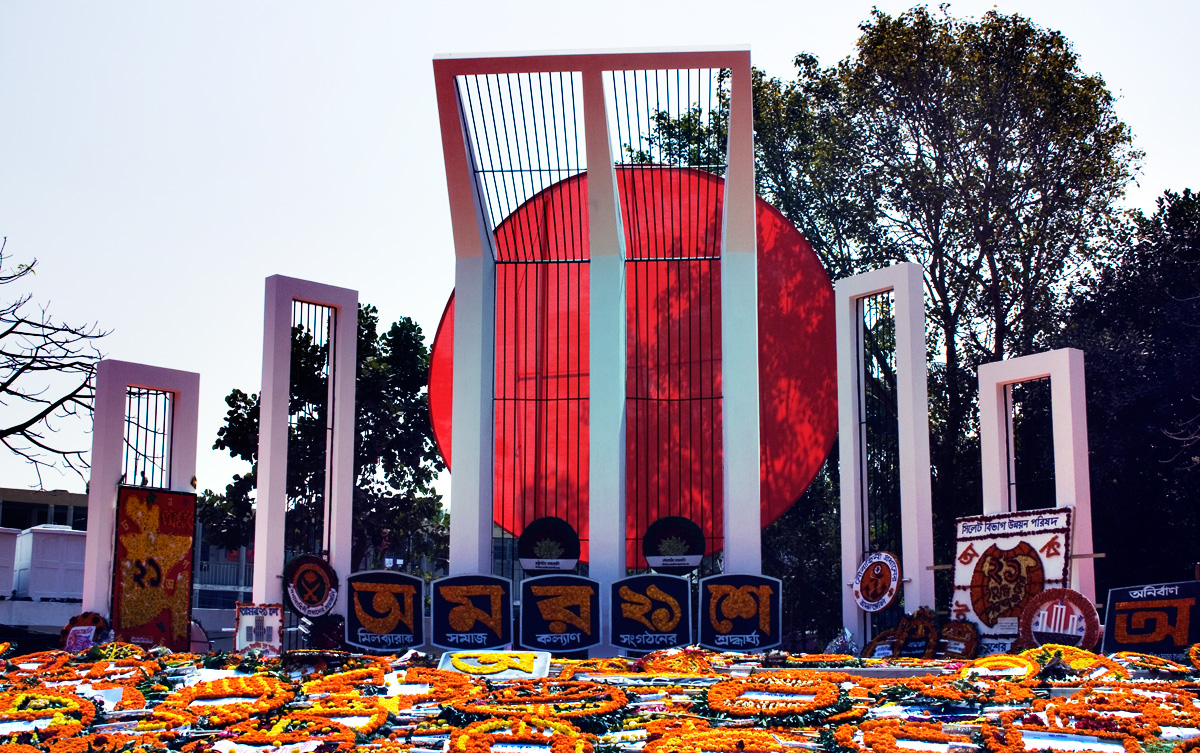
“EKUSHEY FEBRUARY”
The 21st February is the International Mother Language Day. This date is very important to the people of Bangladesh. UNESCO declared the day as International Mother Language Day, on November 17, in 1999. Mother language means the language that is used by the people of a country to express their thoughts, ideas, feelings, emotions etc. It has a glorious historical background. It was 60 years ago on this day that Barkat, Rafiq, Jabbar, Shafiur and Salam, among others, sacrificed their precious young lives for honor and preservation of their mother language, Bangla. It is a matter of pride for all people of Bangladesh, that the supreme sacrifice made on this day in 1952 has eventually led to the recognition of the day to preserve of mother languages worldwide. In 1954, just two years after the event, the United Front government of Abu Hussain Sarker declared a public holiday for this day. Bangla was raised to its highest fame by Rabindranath Thakur (Tagore) when he was awarded in 1913 the Nobel Prize for Literature.
The then Pakistani rulers wanted to impose Urdu as the state language upon us instead of Bangla. But the heroic sons of our country protested it. The students brought out a procession on 21st February in 1952 and the police opened fire on the procession and Salam, Jabber, Barkat, Rafiq died on the spot. Every year we remember this day with profound respect. On this day, everybody holds a black badge and walk to the Shaheed Minar bare footed. They go there to offer flowers on the altar of the Shaheed Minar to show respect to the martyrs. Different social, cultural and political parties observe the day.
On February 23, 1948 in the Pakistan Constituent Assembly in Karachi, Dhirendranath Dutta, a member of the Pakistan Constituent Assembly, made a speech calling for Bengali to be made one of the official languages of Pakistan. He stated as follows:“I know, Sir, that Bengali is a provincial language, but, so far our state is concerned, it is the language of the majority of the people of the state. So although it is a provincial language, as a language of the majority of the people of the state it stands on a different footing. Out of six crores and ninety lakhs [69 million] people inhabiting this State, 4 crores and 40 lakhs (44 million) of these people speak the Bengali language. So Sir, what should be the State language of the State of Pakistan? The State language of the State should be the language which is used by the majority of the people of the State, and for that, Sir, I consider Bengali language the lingua franca of our State.”
However, in 1948 on 19th March, Pakistan’s Governor General Mohammad Ali Jinnah, popularly known as Quaid-e-Azam, claimed at a gathering of students of Dhaka University that Urdu should be the only state language of Pakistan, ignoring the fact that Bangla was the mother tongue of 56% of the people of Pakistan. Soon after in 1950, students formed the “Bangla State Language Action Committee” and worked tirelessly to make Bangla one of the state languages of Pakistan. The immediate starting point of the tragedy of 21st February was that on 27th January, 1952, the then Prime Minister of Pakistan Khwaja Nazimuddin announced at a public meeting that Urdu alone should be the state language of Pakistan. The students were infuriated at the announcement because Nazimuddin as chief minister of East Bengal in 1948 signed an agreement with the leaders of ‘Rashtrabhasa Sangram Parishad’ (State Language Action Committee) with a commitment to adopt a resolution of having Bangla as the other state language of Pakistan by the provincial Assembly. Many members of the Committee were non-students, such as, Professor Abul Kashem, Kamruddin Ahmed, (later Ambassador), Mohammad Toaha, Naimuddin Ahmed (later Advocate) and Abdur Rahman Chowdhury (later a Judge of the High Court).
It may be mentioned that subsequently students of the Dhaka University and Dhaka Medical College took a robust role in the cause of the Language Movement and took a crucial decision and defied the wishes of politicians to violate Section 144 (prohibiting an assembly more than five persons) on 21st February, 1952. The then political leaders did not want to destabilize the political situation by lending support to students to violate Section 144 to delay general election in East Bengal, (later East Pakistan, now Bangladesh).
On 21st February, 1952, agitated unarmed students of Dhaka University, violated Section 144 in protest, to proceed to the elected members of the East Bengal Legislative Assembly ( near SM Hall) and present their demand to Nurul Amin, the Chief Minister. On their way at the site of the Medical College students’ hostel number 12, at 3-30 PM, the police opened fire on the peaceful procession of students by an order of a Magistrate (a West Pakistani).
Jabbar and Rafiq died on the spot, while three others died later in hospital ( an impromptu monument was set up by Medical College students on the site of the current Shaheed Minar). It is believed that many more were killed including a ten year old boy, but their bodies were taken away by the police and were secretly buried. The rest is history.
Every one in Bangladesh has a right to read and write Bangla, and unless free adult education for all ages of people with free learning equipment and school dress for poor children are provided, the purpose of the sacrifice of Bangla language will be defeated.
References:
virualbangladesh.com
dhakacourier.com